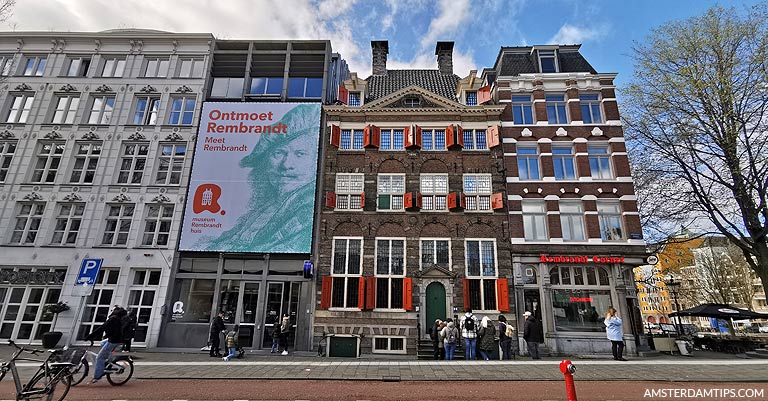
The Rembrandt House (Museum Het Rembrandthuis) is the Amsterdam house where noted Dutch painter Rembrandt Harmenszoon van Rijn (1606-1669) lived.
The Rembrandt House is one of Amsterdam’s most important Dutch Golden Age attractions and gives visitors an insight into the daily life and work of Rembrandt at the height of his artistic fame.
Rembrandt House Museum Amsterdam at a glance
|
Brief History of the Rembrandt House
Rembrandt purchased the house on the well-to-do Sint Antoniesbreestraat (now Jodenbreestraat) in 1639 for the considerable price of 13,000 guilders. He moved in with his wife Saskia Uylenburgh, a burgomaster’s daughter from Leeuwarden.
The house itself was built in 1606, the year of Rembrandt’s birth in Leiden. A few years before Rembrandt moved in, it is thought the house was remodelled by architect Jacob van Campen who designed the Royal Palace on Dam Square.
Rembrandt stayed in the house for 19 turbulent years producing some of his most famous works including The Night Watch which can be seen at the Rijksmuseum.
Saskia gave birth to 3 children in the house that unfortunately died shortly afterwards – they are all buried in the nearby Zuiderkerk. Whilst a 4th child Titus survived, Saskia herself passed away from tuberculosis in 1642 aged just 29 – you can see her grave at Amsterdam’s Oude Kerk.
For a good period Rembrandt enjoyed great prosperity as an artist and teacher and his studio produced a significant output of artworks. In total Rembrandt produced some 300 paintings, 290 etchings and 2,000 drawings over his career. The Rembrandt House has an almost complete collection of his etchings.
Rembrandt also acquired an incredible collection of rarities from all over the world including busts of Roman emperors, Venetian glassware, spears, shells and dried animals.
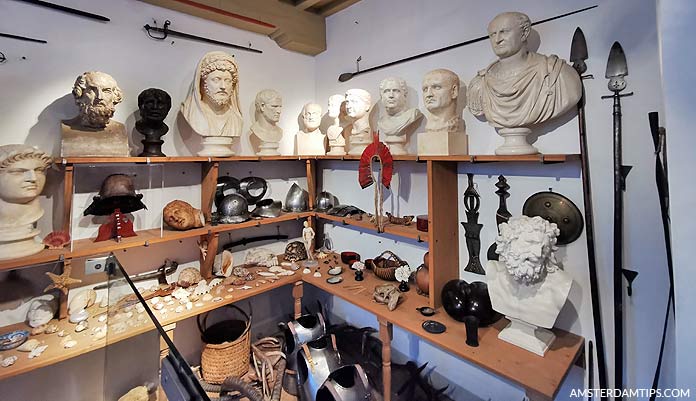
Eventually Rembrandt’s fortunes began to change due to his extravagant lifestyle and a declining art market. In 1658 after persistent problems paying off his debts Rembrandt was declared bankrupt. A detailed inventory of his possessions was made on behalf of his creditors.
He had to move to a smaller rented house on Rozengracht with his mistress Hendrickje Stoffels, her daughter Cornelia and his son Titus. He remained there until his death in 1669. The house in the Jordaan area of Amsterdam was demolished in the 19th century.
For around the next 250 years the Rembrandt house had a number of different occupants before being bought by the city council who turned it over to a foundation. The house was renovated between 1908 and 1911 and then opened as a museum dedicated to the artist.
In 1998 a modern new wing was added next door and the main house was carefully restored. The bankruptcy inventory was vital in helping create an authentic recreation of the home.
The museum underwent a major renovation in 2022-23 adding 30% more exhibition space.
What To See/Do at the Rembrandt House
A visit to the museum takes about 1 hour in a one-way direction with a multimedia audio tour included – available in the following languages: Dutch, English, German, French, Italian, Portuguese, Russian, Spanish, Ukrainian, Arabic, Hebrew, Japanese, Korean, Mandarin Chinese, Turkish and Dutch sign language.

Kitchen
Rooms on the tour include the Kitchen, the most comfortable room in the house due to the constant heat from the fireplace. Note the small box-beds of the day where people slept in semi-upright positions for fear of too much blood rushing to their heads.

Entrance Hall
Visitors arrived into the house via the Entrance Hall which was adorned with paintings for sale by Rembrandt and other masters. There was a small adjacent office where Rembrandt kept his business papers.

Large Studio
The Large Studio was Rembrandt’s main studio where he painted his masterpieces. The room faced north giving optimal light conditions.

Rembrandt’s assistants made up his paints and prepared his canvases.

Small Studio
The Small Studio allowed 4-5 of Rembrandt’s students to work undisturbed in partitioned sections.

Temporary Exhibitions
The modern wing hosts regular temporary exhibitions about Rembrandt, his predecessors, contemporaries and pupils. It also shows works by contemporary artists inspired by Rembrandt.


Rembrandt & Life, a selection of 50 Rembrandt prints showing depictions of passing life from cradle to grave. Runs 12 Jun to 30 Aug 2026.
Experimentation, a look at artists from the 17th century until today who have taken an experimental approach to their art. Runs 25 Sep 2026 to 3 Jan 2027.
There is a shop at the entrance selling various Rembrandt books and reproduction etchings.
Due to the historic building’s narrow staircases, accessibility within the original house is limited. The modern wing is fully accessible.
Also of interest: Rembrandts Amsterdam Experience – A video art experience about the life of the famous painter and reconstruction of Rembrandt’s studio on Rozengracht. Book Rembrandt’s Amsterdam Experience tickets here
Rembrandt House Essential Info
Rembrandt House Opening HoursDaily 10:00-18:00 (17:00 closing time most days in Nov-Dec 2026). |
Rembrandt House Tickets & Admission€23.50 for adults, €15.00 for youths aged 18-25, €8.00 for children 6-17. Free entry for children 0-5, Museumkaart and I Amsterdam City Card holders. Note, special exhibitions can attract a small supplement. Book Rembrandt House tickets here You can order the I Amsterdam City Card online here which includes free entrance to the Rembrandt House. |
How to Get to Rembrandt HouseRembrandt House is located near Waterlooplein, which is served by tram 14 and metro lines 51, 53 and 54 (stop Waterlooplein). |
Address / ContactRembrandt House Museum, Jodenbreestraat 4, 1011 NK Amsterdam |
This article was first published in 2010. Last checked and updated 19 June 2026.
Links on AmsterdamTips.com may pay us an affiliate commission.


